Hunting Cancer With AI Eyes
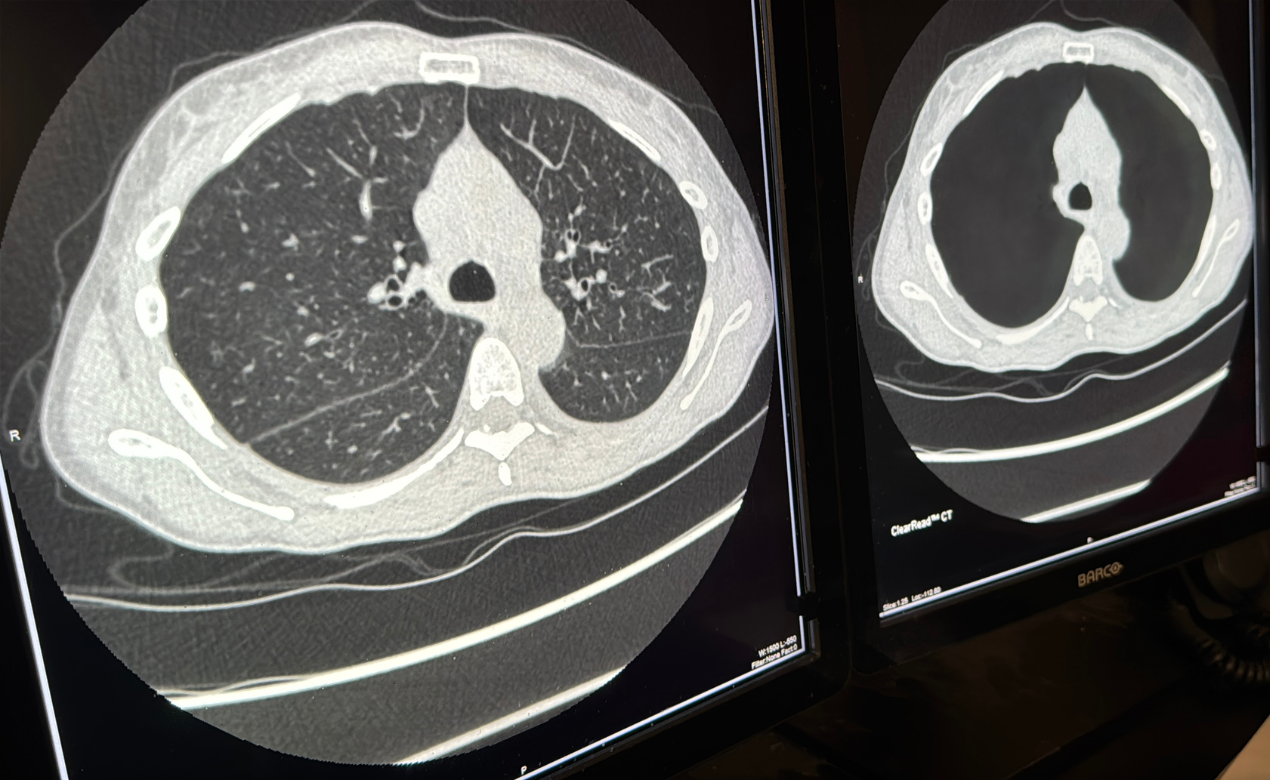 Example of a Lung CT scan, image credits to UC Health.
It's just like in House! (Not really)
I got pretty lost the first time I went into the reading room. Walking past double doors, "Medical Personnel Only" signs,
and cramped hallways, I finally made it. My radiologist PI welcomed me to their base-of-operations, where a team of
Doctors like him, residents, and other fellows read through hundreds of patient's CT scans, X-rays and MRIs. My first impression?
Lots of murmuing. Turns out, to write down these reports text-to-speech workflows are common, so you might hear "abnormality in lower lobe" or simply "cough" spoken into a microphone every few seconds.
Beyond the TTS, the way that experienced clinicians used the software, scrolling through layers in a scan, and picking out tiny lung nodules, small dense anomalous areas that could grow into cancer, out of all the other structures in the lung.
I found it crazy, I mean if you look at the above example of a CT scan, for a layperson like me when it comes to anatomy I couldn't tell you which of the dozens of tiny dots, lines, and structures were actual parts of the lung and which were potentially dangerous. For radiologists, though, this would be just another case in a day's work.
But people make mistakes, might get tired after staring at a screen for 8 hours in a dark room, how might machine learning augment their workflows and make their jobs easier and more accurate? That was one of the main goals of our research team, whether it be computer vision assistance in reading scans, or using LLMs to write/index reports.
Context: How I got the Job
I ended up working in Dr. Sohn's UCSF lab, where radiology meets data science/ML thanks to a matching program at my college. All things considered, Berkeley is pretty all gas-no-breaks when it comes to their research programs. This August, on the 8-hour-drive up from my hometown in Los Angeles County, I found myself on my mobile hotspot browsing at the various projects they had open for students to apply to, many of which had deadlines that closed before Fall classes even started. Blink it and you'll miss.
Thanks to my previous experiences (see: 8 H100s and a Dream), I found myself confident enough in my image-deep-learning skills to apply to this position, especially after seeing how the lab used deep learning for a variety of purposes, not just image-processing. A great chance to broaden my horizons especially in this LLM-focused ML landscape. Turns out, there's plenty of inefficiencies in the current radiology workflow.
That text-to-speech notetaking I mentioned, isn't always accurate and radiologists have to manually say things like "period" or "open parenthesis close parenthesis". Furthermore, new transparency legislation requires that patients be able to see their own radiology reports to keep them in the loop. However, these reports aren't exactly beginner-friendly, and radiologists shouldn't have to compromise important details in an effort to make their reports more accessible. Some people have suggested getting another radiologist to write a simplified lite version of each report, but when there's a radiologist shortage no one wants to essentialily double their labor demands. That's where LLM-based summaries and other patient-facing models can come into play.
If anything, my experiences at this lab reminded me just how important domain expertise is when working on applied AI. One of the factors that might have helped me in getting the job in the first place was that I bothered to read certain landmark papers in the field of bioinformatics, and I brought up relevant ones in my application, relating how my skills connect to the typical technical demands in working on such a project. Having the opportunity to shadow radiologists on-site definitely helped in my understanding of how AI can be used to assist them, beyond the obvious "just use CV to detect cancer". As is our MO as scientists, we have to approach every step of the process with a fresh eye of curiosity: "How can this be better?", "Is this step necessary?", etc.
I'm sure some in the software development space might be a bit tired of managers waxing poetic about user stories or the client's demands but just because certain lessons are stated ad nauseum doesn't make them any less valuable!
Reflections
As this is my first semester working at this lab, I still have much to learn as I'm finishing up onboarding training and getting settled into my first proper project. Since we are researchers working with sensitive/confidential patient information, I probably shouldn't be leaking too much alpha (lmao) in these blog posts, but I'll hopefully update this with something if I manage to get a paper published or code shipped to a production setting.
Overall, I'm incredibly grateful to Berkeley's undergraduate research program and the faculty/grad students at the lab for this opportunity, especially the latter for being such a welcoming presence as I take a stab at bioinformatics research.
 A cool-looking pillar I saw on the way to the lab